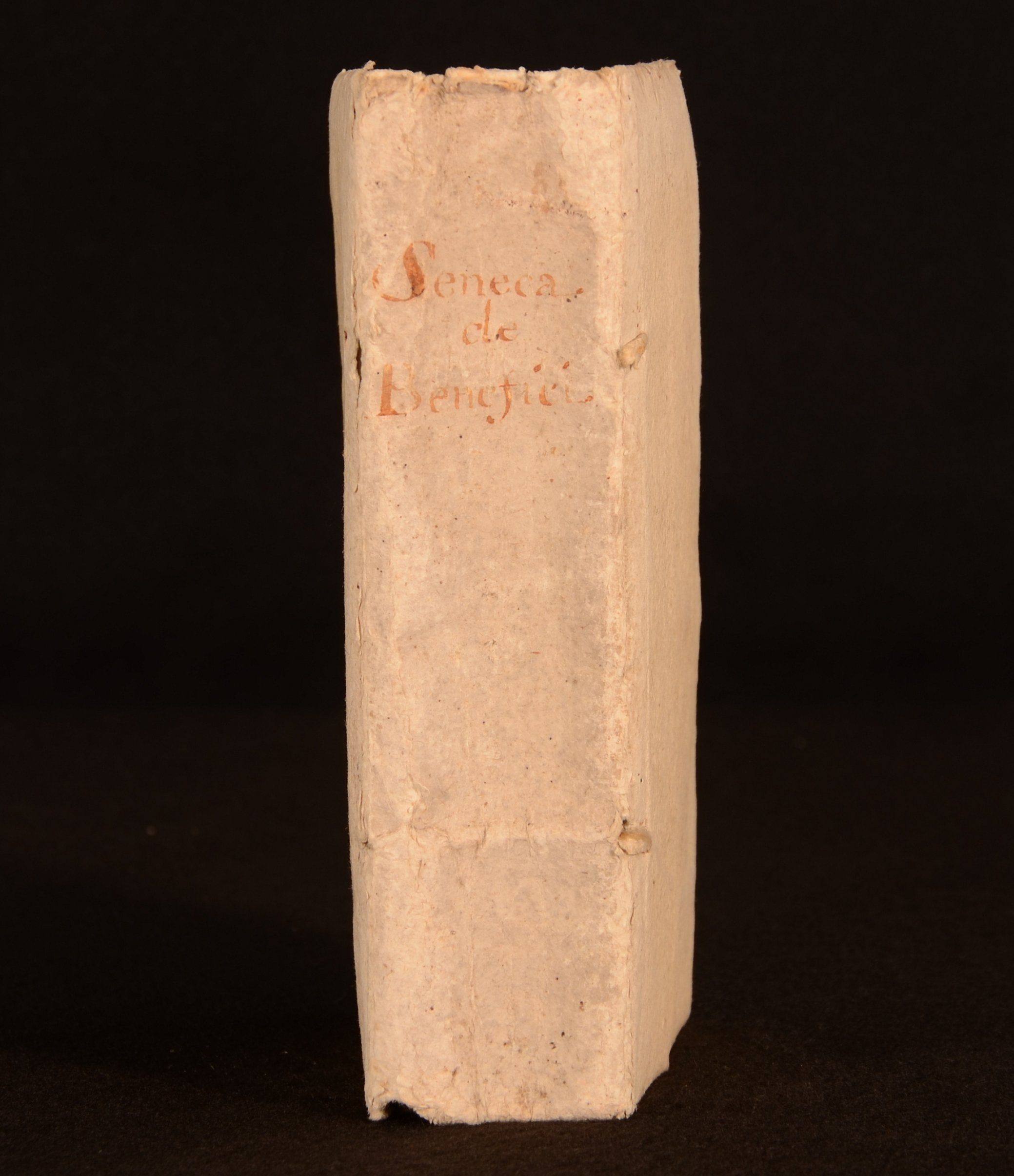
Seneca — Seneca de Beneficii Trasportato Dal Latino Da Angelo Nicolosi Segretario Dell Eccelso Conseglio Di Dicci
Venice, Appresso Giouanni Cagnolini, 1682. Hardback. An Italian edition of Seneca the Younger's collection of essays discussing morals and gifts, 'De Beneficii', illustrated with a woodcut vignette to the title. In Italian. This work is a duodecimo, with the signatures running as [1], *3-*5, A-B12, B1, C2-12, D-Z12, Aa-Ee12, Ff7. With a woodcut vignette to the title. With one page of errata to the rear. An edition of Seneca the Younger's work 'De Beneficiis', a work that was written in the first century. It's a collection of moral essays, in which Seneca discusses the habit of giving and receiving gifts in society, and the act and role of gratitude. The title translates as 'On Benefits', deriving from the Latin word 'beneficium', which means a favour, kindness, service, or benefit. The work is comprised of seven books, through which Seneca's aim was to regulate a practice through a discussion of benefits. The idea of 'beneficia' was important to Seneca, as he considered it as an act that morally bound humans in society. The nature of benefits is a social exchange, and Seneca discusses the role of the individual within this exchange. The work could be thought of as a work on social ethics, most especially Stoic ethics. In the work, Seneca also discusses ethics with regards to political leadership, an interesting subject considering the tyrannical Nero was the Emperor whilst Seneca was writing the work. As is usual with early works, it is debated when exactly the work was first written. It is generally argued that is was written between the years 56 and 62 AD. He also discusses the lives of Roman aristocrats, and their relationships. The work was well admired, especially by Christian thinkers during and after the twelfth century. The French Renaissance philosopher Michel de Montaigne admired the work. Seneca the Younger was a Roman stoic philosopher and satirist, and was the son of the Roman writer Seneca the Elder. He is best known for his philosophical works, as well as for his tragedy plays. He also wrote one hundred and twenty-four surviving letters, which all deal with moral issues. His work provides the most important resource for ancient Stoicism. In a full parchment binding. Externally, generally smart. Light rubbing to the boards and spine. A few light marks to the boards and spine. Bumping to the head and tail of spine and to the extremities. Title to the spine has faded a little. Rear hinge is failed and is attached by the rear endpaper only. Front hinge of starting. Ink mark to the front pastedown and to the verso of the front free endpaper. Internally, generally firmly bound. Pages are bright and clean. Textblock B and Ff is working loose. Good Only . Ill.: None. Good Only .