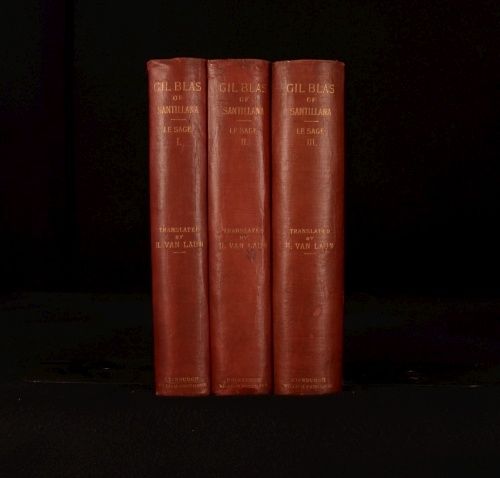
Alain-René Lesage — The Adventures of Gil Blas of Santillana in Three Volumes
Edinburgh, William Paterson, 1886. Cloth. An attractive, ilustrated set of The Adventures of Gil Blas of Santillana. Complete in three volumes. These volumes are number three of a limited print run of one hundred and twenty-five copies. Translated from the original French by Henri Van Laun. Gil Blas (French: L'Histoire de Gil Blas de Santillane) is a picaresque novel by Alain-René Lesage published between 1715 and 1735. It is considered to be the last masterpiece of the picaresque genre. Gil Blas is born in misery to a stablehand and a chambermaid of Santillana in Cantabria, and is educated by his uncle. He leaves Oviedo at the age of seventeen to attend the University of Salamanca. His bright future is suddenly interrupted when he is forced to help robbers along the route and is faced with jail. He becomes a valet and, over the course of several years, is able to observe many different classes of society, both lay and clerical. Because of his occupation, he meets many disreputable people and is able to adjust to many situations, thanks to his adaptability and quick wit. He finally finds himself at the court as a favourite of the king and secretary to the prime minister. Working his way up though hard work and intelligence, Gil is able to retire to a castle to enjoy a fortune and a hard-earned honest life. Gil Blas is related to Lesage's play Turcaret (1709). In both works, Lesage uses witty valets in the service of thieving masters, women of questionable morals, cuckolded yet happy husbands, gourmands, ridiculous poets, false savants, and dangerously ignorant doctors to make his point. Each class and each occupation becomes an archetype. This work is both universal and French within a Spanish context. However, its originality was questioned. Voltaire was among the first to point out similarities between Gil Blas and Marcos de Obregón by Vicente Espinel, from which Lesage had borrowed several details. Considering Gil Blas is essentially Spanish, José Francisco de Isla claimed to translate the work from French into Spanish in order to return it to its natural state. Juan Antonio Llorente suggested that Gil Blas was written by the historian Antonio de SolÃs y Ribadeneyra by arguing that no contemporary writer could have possibly written a work of such detail and accuracy. In red cloth bindings with gilt embellishment on the front boards and gilt lettering to the spines. Externally, smart with slight rubbing. Spines are slightly cocked and sunned. Corners are bumped. Internally, generally firmly bound, though binding is loosening in places. Hinges are slightly tender. Pages are generally bright and clean, with some scattered foxing. End-papers in all volumes are browned, with off-setting from frontispieces and engravings throughout volumes. Very Good . Ill.: None. Very Good .