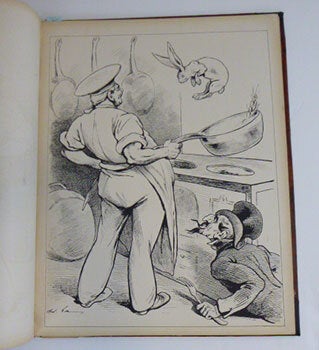
Gill (Louis-Alexandre Gosset de Guines, dit André); André Gill, (1840-1885). Illustrateur; ... Yves et Barret, engraver; Cecil B. DeMille, provenance — Album de la Lune Rousse. [Collection of Large Format Caricatures]. First Edition
Paris: 1877. Portfolio of 26 engravings. 63.5 x 48cm. Edition of 100..Contemporary marbled boards with later half goatskin. Plates engraved by Yves & Barret. Very large format caricatures of Léon Gambetta; Président Grévy; Paulin Ménier, rôle de Rodin, dans le Juif errant; Judic et Dupuis; Route d'Orient; Le loup, la chèvre et le chou (vieux problème) [avant la lettre] and 22 others... Album de la Lune rousse - (épreuves sur papier bristol, tirées sur pierre, des 26 premiers dessins de la Lune rousse par Gill ; portefeuille à 100 ex. publié fin mai 1877) ;BnF: Notice n° : FRBNF32809726... Bookplate of Cecil B. DeMille, the legendary filmmaker, who was a noted book collector and maintained an enormous, exceptional library with a custom phoenix-themed bookplate designed by artist Paul Iribe in 1924. His collection reflected a need for deep historical research and artistic inspiration for his lavish epic films..............................OCLC Number / Unique Identifier: 472451769 Notes: Le journal a publié 3 numéros exceptionnels (8 mars 1877, Victor Hugo et la Légende des siècles; 5 juillet 1877, M. Thiers; 13 août 1878, Léon Gambetta) et 2 albums : "Album de la Lune rousse" (épreuves sur papier bristol, tirées sur pierre, des 26 premiers dessins de la Lune rousse par Gill; portefeuille à 100 ex. publié fin mai 1877).. Yves et Barret (fl. c. 1870 - 1890) were French engravers active in the late 19th century. They engraved political cartoons and other images for French periodicals, including La Vie Parisienne. This partnership was known for creating works using gillotage, a now obsolete lithographic process wherein a drawing was made on or transferred to zinc and then dusted with resin, which adhered to the drawing. The resin then acted as an acid-resist when the entire plate was immersed in acid, creating a relief block that could then be inked and printed from. This printing technique was popular with newspapers, as it was completely compatible with blocks of type. .