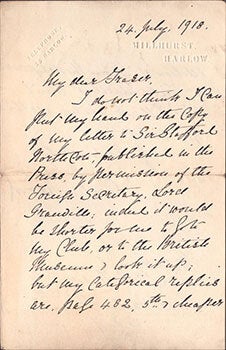
Wood, Field Marshal Sir Henry Evelyn Major General (1838-1919); Sir Thomas Fraser (1840-1922) recipient — Letter from Field Marshal Sir Henry Evelyn. Als to Major General Sir Thomas Fraser. Original Autograph Documents
Millhurst, Harlow: 24 July 1919. Als. 2pp. Addressed to Major General Sir Thomas Fraser........referencing his published letter to Sir Staqford Norothcote and Lord Grandville's permission.........Field Marshal Sir Henry Evelyn Wood, VC, GCB, GCMG, DL (9 February 1838 - 2 December 1919) was a British Army officer. After an early career in the Royal Navy, Wood joined the British Army in 1855. He served in several major conflicts including the Indian Mutiny where, as a lieutenant, he was awarded the Victoria Cross, the highest award for valour in the face of the enemy that is awarded to British and Imperial forces, for rescuing a local merchant from a band of robbers who had taken their captive into the jungle, where they intended to hang him. Wood further served as a commander in several other conflicts, notably the Third Anglo-Ashanti War, the Anglo-Zulu War, the First Boer War and the Mahdist War. His service in Egypt led to his appointment as Sirdar where he reorganised the Egyptian Army. He returned to Britain to serve as General Officer Commanding-in-Chief Aldershot Command from 1889, as Quartermaster-General to the Forces from 1893 and as Adjutant General from 1897. His last appointment was as commander of 2nd Army Corps (later renamed Southern Command) from 1901 to 1904... ; Major-General Sir Thomas Fraser (1840-1922), a retired British Army officer and Royal Engineer, published the political-military treatise The military danger of home rule for Ireland. He was a decorated veteran of the First Boer War and Anglo-Egyptian War, later appointed Colonel Commandant of the Royal Engineers in 1913.. Isaac William Ward (1834-1916), born in Belfast, composed an article in 1906 for the Ulster Journal of Archæology entitled "Belfast Castle, Donegall House, and Ormeau House, the Residences of the Donegall Family." He used the pen-names "Belfastiensis" and "Linea" when contributing to Belfast newspapers and journals. I have hereby reproduced a slightly condensed version of his article. Isaac Ward lived at 22, Camden Street. He came from a noted Belfast family which farmed land where the Malone Golf Course is now located. He was among the foremost observers of the day, despite the fact that his sole observing instrument was a 4.3-inch refractor. According to David Beesley, his chief handicap was his own modesty, a trait that prevented his genius from being more widely appreciated. .