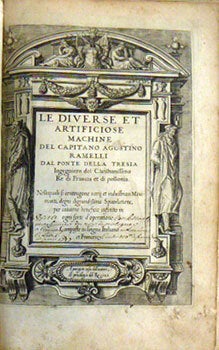
Ramelli, Agostino (1531-1600); Léonard Gaultier (1561-1641), artist; Jean I. de Gourmont (1483-1522/3), engraver — Le Diverse Et Artificiose Machine / Del Capitano Agostino Ramelli... Nellequali Si Contengono Uarij Et Industriosi Mouimenti, Degni Digrandissima Speculatione, Per Cauarne Beneficio Infinito in Ogni Sorte D'Operatione. Composte in Lingua Italiana Et Francese. First Edition
[Paris]: In casa del'autore, c ?priuilegio del Re, A parigi, 1588. Small folio. 21 x 32cm. 18th Century garnet morocco, ribbed spine, gilt lace edges; the covers repaired. Marble endpapers... [32]pp; 336 leaves: this copy lacking 37 leaves with 29 engravings; 166 of the 195 engraved plates, some double page are present. List of missing plates on request...This seminal book consists of engravings of various machines devised by the engineer Agostino Ramelli (1531-c. 1610). Born in southern Switzerland, Ramelli served in the French army during the Wars of Religion (1562-98) and proved himself a competent engineer during the 1572 siege of La Rochelle which brought him to the attention of the future King Henri III (reigned 1574-89).. In 1588, Ramelli published this book, written in French and Italian. It provides detailed images of both civic and military machines. More than half of the volume consists of engravings of pumping machines and water mills, while another large section is devoted to ingenious siege engines. Ramelli also included a design for a book wheel, a device which allows a person to read multiple books at once, and a design allowing servants to water plants without being seen by the household... This fundamental work for the history of technology offers a panorama of instruments and machines engraved in intaglio on 166 (out of 195) full-page or double-page plates, featuring pumps, fountains, derricks, movable bridges, forges, cranes, siege engines, book wheels, etc. which inspired the iconography of mechanics books for more than two centuries. The work is also adorned with a rich title frame and a portrait of the author engraved by Léonard Gaultier (1561-1641). Agostino Ramelli (1531-1590), a native of Ponte Tresa, trained as a mathematician and then participated in the Italian Wars as a military engineer. Upon his arrival in France, he placed himself under the protection of the Duke of Anjou, the future Henry III, the work's dedicatee.. OCLC Number / Unique Identifier: 457486551; Adams R-52; Brunet IV, 1095; Heralds of Science 173; Mortimer, Harvard French 452; Norman 1777 ('The plates in Ramelli's treatise are artistically as well as technologically superb'); Riccardi I, 341. .