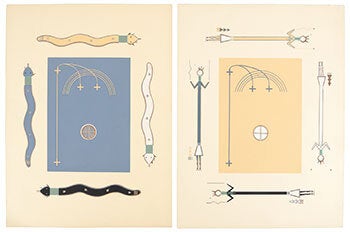
Oakes, Maud Van Cortlandt (1903-1990), artist — Complete Set of 18 Silkscreens for "Where the Two Came to Their Father: A Navaho War Ceremonial Given by Jeff King. " First Editions
[New York,: Pantheon Books Inc. 1943]. 18 pochoir serigraphs. 45x60 cm (17¾x23¾").Plate numbers embossed in lower right corners.. Very good.... Plate 1 has loss at two lower corners.. Maud Van Cortlandt Oakes, ethnologist, writer, and artist, was born on 25 May 1903 in Seattle, Washington and grew up in Manhattan, New York. Beginning as a painter, Oakes developed an interest in ethnology while vacationing on Bainbridge Island in Puget Sound in Washington state. She chronicled the cultures of indigenous tribes in the American Southwest and the Mam of Guatemala.. She died in June 1990 at her home in Carmel, Calif. She was 87 years old. T Miss Oakes was born in Seattle and grew up in Manhattan.. This series of silkscreen prints takes its title from the Navajo creation story, a richly symbolic legend that the Navajo people incorporated into ceremonial blessings for warriors heading into battle...OCLC Number / Unique Identifier: 1316716596... The legend recounts the birth of twin heroes Monster Slayer and Child Born of Water and their quest to find their supernatural Father in the House of the Sun, from which they returned to earth stronger and wiser. The story speaks not only to creation, but also to kindness, death, and deception. The ritual that embodies the story imparts a divine sense of power to the warrior. Dating back several hundred years, the nine-day, nine-night ceremony was performed by medicine men to prepare those going to war and those left behind.... Jeff King (1860-1964). whose Navajo name was Haska-zilth-e-yah, was one of the most respected medicine men in the Navajo Nation in the first half of the 20th century. King was a scout in the U.S. Army and was buried in Arlington Cemetery when he died in 1964. He is remembered for his efforts to preserve the Where the Two Came to Their Father ritual and accompanying sand paintings, which had been largely forgotten by the early 1900s... Ethnologist Maud Oakes observed the rite during World War II, when Native Americans were drafted into the U.S. military for the first time. She used gouache on deer hide to copy and preserve King's original paintings executed in sand, pollen, corn meal, and ground flowers. Based on her gouache copies, the screenprints exhibited here comprise a portfolio which was first published in 1943 with text written by Oakes and additional commentary by Joseph Campbell.... Plates illustrating the Navajo War Ceremony known as Where the Two Came to Their Father, performed for Navajo soldiers preparing to go to battle, and tells the story of two brothers, the Hero Twins, who meet their father at the House of the Sun to receive the power to fight monsters oppressing their people. Does not include the text volume or portfolio... This rendition was recorded by Maude Oakes, as given by Jeff King (Haska-zilth-e-yah, 1865-1964), who invited Oakes to observe the ceremony and provide as accurate an accounting of it as possible. The images replicate the sandpaintings that are ritually created and destroyed during the ceremony. King was one of the highest-regarded of the Navajo medicine men (hataatii) in the modern era, and was the first Navajo/Dine person to be buried in Arlington National Cemetery.