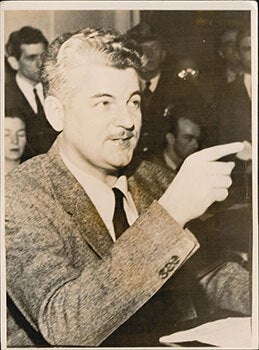
New York Times Photos, Paris — Portrait of Eugene Dennis, National Chairman of the Communist Party in 1947 Original Photograph
1947. Silver print. French text on separate sheet pasted to verso. Photographer's stamp verso. 18 x 13 x cm.. NYT, February 1, 1961: Eugene Dennis, national chairman of the Communist party in the United States, died yesterday of cancer in Mount Sinai Hospital. He was 56 years old. His home was at 626 West 151st Street. Mr. Dennis was general secretary of the Communist party in this country from its peak period in 1945, when it numbered about 80,000 members, to its decline in 1957, when the membership was about 20,000. It is now believed to be fewer than 10,000. In 1957, Mr. Dennis became the party's secretary of national affairs and a member of its executive committee. He was named national chairman in December, 1959. The party had been split by factionalism after the Soviet Union's show of force in Hungary, in 1956. He supported Russian action to quell the Hungarian uprising but advocated greater party independence from Moscow dictation. He led middle-of-the-roaders opposing William Z. Foster, then national chairman, who demanded continued allegiance to Russia. When, in 1957, the party received a letter from Jacques Duclos, top French Communist, chiding it for "dangerous" tendencies and urging solidarity with Soviet foreign policy, Mr. Dennis said: "Our decisions will be our own."... In 1956 he said the party had lost its influence and became politically isolated by policies too far to the left. He wrote an article for The Daily Worker asking whether Premier Khrushchev of the Soviet Union and his colleagues could not have done something to restrain Stalin's terror. He thus took a considerably more moderate position than Mr. Foster, a stanch Stalinist... Mr. Dennis invoked the Fifth Amendment in an appearance in February, 1957, before the Senate Internal Security subcommittee in Washington and refused to testify.. Mr. Dennis had been a member of the party since 1926. In 1949 he was convicted under the Smith Act as one of the eleven "first-string" Communists tried in Federal Court here for conspiracy to teach and advocate the overthrow of the Government by force and violence. Judge Harold R. Medina, who presided at the nine-month trial, sentenced him to five years in prison. Higher courts upheld the sentence, and the Communist leader served three years and nine months in Atlanta Penitentiary, from July 22, 1951 to March 1, 1955, receiving time off for good behavior. .