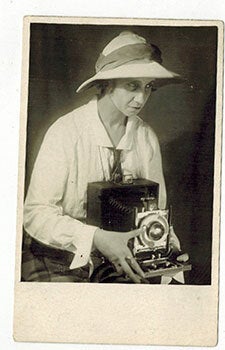
Tretyakov, Sergei Mikhailovich (1892-1937) — Portrait of "Liza the Tourist" in "Roar China. "First Edition of the Photograph
Moscow: circa 1929-1930. Original photograph. 14 x 8.0cm.. Sergei Mikhailovich Tretyakov (Russian: ??????? ??????????? ??????????; 20 June 1892, Goldingen, Courland Governorate, Russian Empire (today Kuld?ga, Latvia) - September 10, 1937...Sergei Tretyakov's now-famous writings about Asia-works such as Roar China (the 1924 poem and 1926 play) and Den Shi-khua (1927)-sought to break from Western exoticism and chinoiserie. However, there has been scholarly debate about whether he, in fact, reinforced Eurocentric views of Asia, for instance, by depicting Chinese laborers using a naturalist rather than avant-gardist aesthetic. This talk weighs in on this debate by turning to Tretyakov's earlier depictions of other Asians, namely the Japanese and Koreans that he encountered in Vladivostok in the early 1920s, prior to his first visit to China. I will focus on feuilleton pieces he wrote using such "Asian" pennames as "Tiutiun" and "Zhen'Shen'", as well as representations of Asia in the futurist journal Tvorchestvo (Creation), which he co-founded. Particular attention will be paid to his attempts at agitational tanka poetry and their use of Japanese language, which I consider in relation to a larger tradition of modernist orientalism (e.g. Ezra Pound's and Sergei Eisenstein's engagement with Chinese language). What I find is a Tretyakov still drawn to exoticism and the estranging possibilities of non-European languages, resulting in aesthetically innovative work with little of his later obsession with ethnographic fidelity. His interest in overcoming linguistic and cross-cultural mediation would arise only after his visits to China, as well as his service in the Education Ministry of the short-lived Far Eastern Rep.. Provenance: From the collection of Alma Law, the American scholar of the Russian theater. .