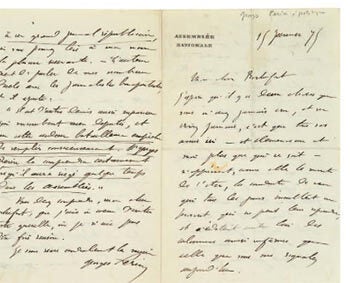
Raspail, François-Vincent Aurélien Scholl; Georges Perin ; Alfred Madier-Montjau ; Auguste Vacquerie; Rochefort, Henri (1831 - 1913); Anti-Dreyfusard — Original Letters to the (the Later) Anti-Dreyfusard Henri Rochefort from François-Vincent Raspail; Aurélien Scholl; Georges Perin ; Alfred Madier-Montjau ; Auguste Vacquerie
France: 1871-1879. 5 Lettres adressées à Henri ROCHEFORT, 1871-1879. François-Vincent Raspail, 11 mars 1871. Lettre signée à un rédacteur au sujet de la maladie de Rochefort.. Aurélien Scholl, 29 août, sur l'attitude du Voltaire avant les élections sénatoriales: "J'emboite le pas à Gambetta qui dispose seul de forces suffisantes pour conjurer le péril de la rentrée".. Georges Perin, 15 janvier 1875; le député s'insurge avec Clemenceau contre "la conduite de ceux qui tous les jours insultent un proscrit qui ne peut leur répondre, et éditent contre lui des calomnies".. Alfred Madier-Montjau, 23 mars 1879, longue lettre de 6 pages du député au sujet des poursuites du Parquet et des persécutions contre le journal La Marseillaise.. Auguste Vacquerie, 25 avril 1879, il le félicite pour un article et pour son roman L'Évadé, en espérant le revoir bientôt à Paris....... Provenance: Bibliothèque Philippe Zoummeroff, Crimes et Châtiments. Expertise by Thierry Bodin; Jacques T. Quentin; Benoît Forgeot... Henri Rochefort, the main anti-Dreyfusard polemicist, was born in Paris on 31 January 1831.. The son of the marquis de Rochefort-Luçay-himself a journalist and playwright-Henri Rochefort became an employee of the city of Paris in 1851. A sub-inspector for the Ecole des Beaux-Arts, he resigned to work at Le Figaro before founding his own paper, La Lanterne. A deputy from the Seine department in January 1871, he was sentenced to be deported to New Caledonia after the Commune. He escaped in March 1874, and was amnestied in 1880.. He then founded L'Intransigeant, which denounced-in tens of thousands of copies-"parliamentary filth." Reelected deputy in 1885, he resigned the following year when he failed to obtain a general amnesty. He supported General Boulanger, which earned him another conviction from the High Court for "conspiracy against the safety of the State.".. He was amnestied in 1895, and joined the ranks of the nationalists and the anti-Dreyfusards, accusing Joseph Reinach of having faked the evidence against Esterhazy. On 13 December 1897, L'Intransigeant published the story of a letter from the German emperor naming "Captain Dreyfus throughout." The governmental refutation met with "only incredulity among the enlightened apostles of the nationalist gospel" (M. Paléologue).. In 1898, as president of a marginal French socialist party, Rochefort denounced Jaurès as "a sergeant recruiter in the service of the syndicate of treason." On 18 October, he wrote that his dream would be to line up the judges of the Court of Cassation, have an executioner cut off their eyelids, gouge out their eyes, and then place them on a large pillory with a sign reading "This is how France punishes the traitors who sell her to Germany!".. His paper denounced the "syndicate" of the Dreyfusards, and supported the anti-Dreyfusards who, at Rennes, nourished the idea that the captain was the incarnation of treason, calling the line of soldiers who turned their back on Dreyfus to discourage death threats a "dishonor guard." He saw anti-Dreyfusism as a means to attack bourgeois values and Jewish financiers, but refused to write for L'Action Française. The last of his 13,000 articles appeared in La Patrie before his death at Aix-les-Bains in the Savoie department, on 1 July 1913. .