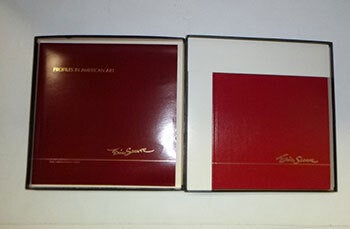
Meyer, Claudia; Ken Meyer — Eric Sloane. An Artist's Legacy. . Profiles in American Art. First Editions of the Signed Limited Collector's Edition Book and Stereo Video Disc
Boulder, Colorado: Ken Meyer Productions, 1982. Cloth bound book and video disk in slipcase. Both signed by the artist as one of 100 copies...Nina Sangimino: Born Everard Jean Hinrichs in in New York City 1905, he died i 1985... Eric Sloane adopted his professional name to reflect his reverence for both America and his mentor at the Art Students League, Ashcan master John Sloan. Sloane began his artistic career as a traveling sign painter. His 1925 journey in the Ford Model-T that he "borrowed" from his family proved instrumental to his development. Time spent in Lancaster, Pennsylvania, working for Amish craftsmen, garnered Sloane's deep appreciation for agrarian life, which he studied for later publications such as American Yesterday (1956), Diary of an Early American Boy: Noah Blake, 1805 (1962), and Eric Sloane's Do: A Little Book of Early American Know-How (1972). Reaching Taos, New Mexico, later in the trip, the vast horizons and panoramas of the Southwest sparked an intense interest in meteorology...... He began painting "cloudscapes," for which he became so well known that in 1976 he was commissioned by the Smithsonian National Air and Space Museum to paint a mural in the Boeing Milestones of Flight Hall. His early literary career included manuals for the US Air Force describing weather patterns, and he became so enthralled with the subject that he enrolled in the Massachusetts Institute of Technology to understand the science of weather more thoroughly-his distaste for math, however, prevented him from completing his coursework. He also felt that the MIT program had a "lack of romance," to which a professor responded, "If it is romance in the weather you're searching for, you would do better to study the almanacs and farm diaries of the Early American."........In 1939, he briefly took a position as broadcast weatherman for the Dumont television station in New York City. "Going downtown to the Weather Bureau to study government weather maps in the morning, back to the television's station at noon to prepare the show, and then being made up (they all used heavy makeup in those days), took up the whole day and my seven o'clock show left me exhausted after the 'three-minute' effort.. Painting was easier."[. .