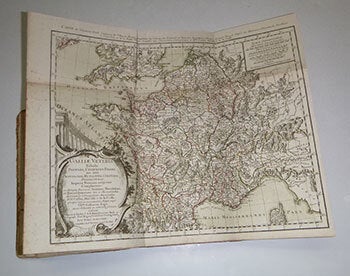
Rizzi-Zannoni, A Giovanni Antonio (Cartographer- 1736-1814); Louis-Charles Desnos (Publisher); Le Charpentier, etcher — Atlas Historique de la France Ancienne Et Moderne : Contenant Tous Les Lieux Illustrés Par Les éVénemens Les Plus Mémorables de Notre Histoire; Les Conquêtes, Les Pertes Et Les Succès de la Nation; Ses Alliances Et Ses Traités Avec Les Puissances Européennes; Les Batailles, Les Sièges, Les Conciles Qui Se Sont Tenus En France; Les Ordres Religieux Qui S'y Sont établis; L'étendue Des Grands Fiefs Et Leur Reunion à la Couronne Enfin Toutes Les Révolutions de la Monarchie Dans Chaque Siècle Et Sous
Paris: mis au jour et éxécuté par le S. Desnos Ing. Géogr. pour les Globles, Sphères, et Instrumens de Mathémat. Rue S. Jacques, au Globe, 1765. 4to, 21.5 x 27cm. Contemporary qtr. gilt calf and boards, worn. With 56 double pages handcolored maps and 2 large fold-out maps. Lacking map no. 2. OCLC Number / Unique Identifier: 557434253..Giovanni Antonio Bartolomeo Rizzi Zannoni was one of the leading cartographers of the late 18th century, as well as being an astronomer, surveyor and mathematician. Born in Padua, he worked in Venice and was engaged by the governments of Austria and France to produce maps. Rizzi Zannoni was the first to execute the triangulation of Poland, assisting in the French and English border survey of American in 1757, and serving as the hydrographer of the Dépot de Marine. He was also a member of the Cosmographic Society of Göttingen, a town in Saxony, Germany, home to the University of Göttingen. Rizzi Zannoni is known for his world atlas, the French edition of which was published in 1762 as Atlas Moderne by Lattré in Bordeaux. In 1781, he was invited by the Bourbon rulers of the Kingdom of Naples to direct the Topographical Office, among the first governmental cartographic agencies in Europe. There he produced celebrated land and maritime atlases of the region, as well as many separately issued maps. His Atlante Marittimo delle due Sicile (1793) is cited by map historian R.V. Tooley as "remarkable for a marvelously minute attention to detail, and amply deserves the commendation passed upon it by Sir George Fordham" (Tooley, 21). .