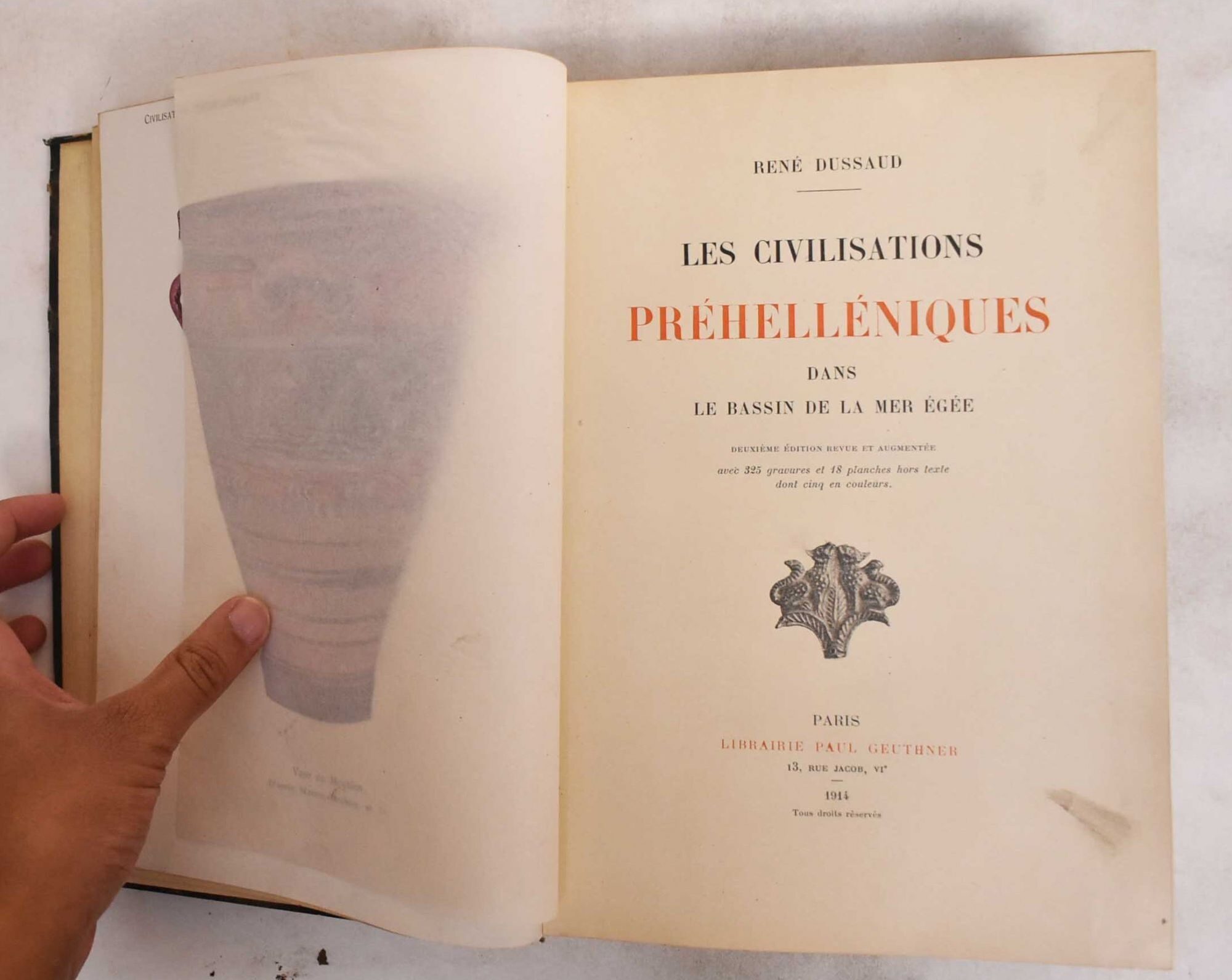
Dussaud, René — Les Civilisations Préhelléniques Dans le Bassin de la Mer égée
Paris, P. Geuthner, 1914. 2nd edition. Hardcover. Marble board covers. x, 482 pages : color frontispiece, illustrations, 13 plates (4 color) folded map, folded plan, 2 table (1 folded) ; 27 cm. Text in French. Translated "The civilizations pre-Hellenic in the basin of the sea Aegean" Contents: Chapter I. The Crete preHellenic - 1. In the story the early history - 2. Cnossus - 3. Phaestos and Agia Triada - 4. The various types of falls - 5. Ceramics and Chronology - 6. The Museum of Candia and Minoan Art - Chapter II. The Cyclades - 1. Primitive tombs - 2. Thera - 3. Delos - 4. The obsidian trade in the Aegean Sea and the founding of Phylacopi (Milo) - 5. The three superimposed cities of the site of Phylacopi - 6.The ceramic - Chapter III. Troy and the Troad - 1. The successive installations on the website of Troy - 2. The ceramic in Troas - 3. The civilizations of the Trojans prehistoric and of the Homeric Troy - Chapter IV. The mainland Greece and the Mycenaean civilization - 1. Mycenae, Tiryns and the Peloponnese - 2. Attica Thessaly - 3. Comparison of Minoan and Mycenaean architecture - 4. Origin and distribution of theMycenaean civilization - Chapter V. Cyprus - 1. Digger excavators - 2. Caracteres general of the Neolithic age and the ages of copper and bronze - 3. The ceramic - 4. The copper industry and bronze before the Iron Age - 5. Miscellaneous objects. Fusaioles. Cylinders and seals. Jewelry. Ivories - 6. The early days of the Iron Age - Chapter VI. Aegean influence in Egypt and Syria - 1. The Aegea Ns in Egypt - 2. Aegean and particularly Cypriot influence, in Palestine, Phenicia and Syria - 3. Philistines, Zakkarou, Phelétites and Kerétites - 4. Cypriot and Phoenician art - Chapter VII. Cults and Myths - 1. Places of worship - worship 2. Objects - 3. Idols and rituals - 4. Myths and the legends - 5. Worship of the gods and worship of the dead - Chapter VIII. The Aegean peoples - 1. Navigation - 2. The Aegean scriptures and the question of the alphabet - 3. The language - 4. The race - Conclusion: The documentary value of the Homeric poems. G, covers are worn, spine is gone. Hinges are loose. Pages have slight toning along edges but otherwise clean. Good reapir or re-bind candidate.