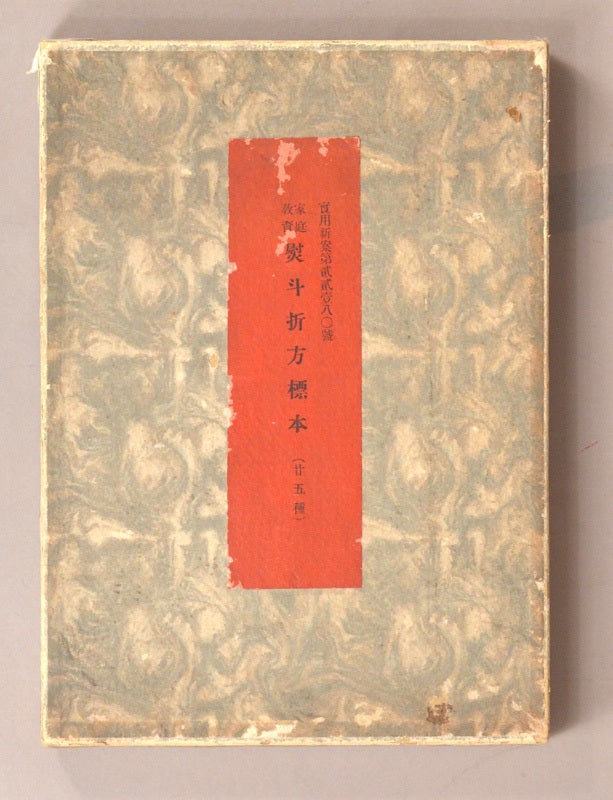
[Paper Ephemera - Noshi Samples] — Noshi Orikata Hy? Hon ?????? (Katei Ky?Iku ????)
[Paper Ephemera - Noshi Samples] Noshi Orikata Hy? Hon ?????? (Katei Ky?iku ????) Taisho 2 ??? [1913] Cardboard box 26 x 19cm holds a booklet, paper folder and individual folded papers. The 17 pp booklet has olive embossed paper wrappers, orange and beige thread tassels and a printed title slip with Ogasawarary? Noshi Orikata ???? - ???? ??? [Explanatory Booklet on Folding Ogasawara-style Noshi]. A closer look at the box contents reveals a large folded sheet 25.5 x 18.5cm (which likely held the paper sheets before they were folded) of the same heavy olive paper as the book wrappers and a printed title slip that matches that of the box cover, as well as 26 folded sheets in various colors, including purple and red. All but one of the folded papers has a single character on one side and most have Japanese writing on the other. There are broken and solid lines to aid in folding. Each of the folded papers seem to represent a different style of noshi resulting in square, triangular, rectangular and other shapes. Japanese text throughout, with the title handwritten on the front edge of the box. The book frontispiece is a black and white reproduced photo of an elegant display of folded paper noshi ?? and mizuhiki ?? tied cords on trays. Explanatory text, two introductions and a Table of Contents follow. The remainder of the booklet has explanations and diagrams on folding noshi ?? and tying mizuhiki ?? and the last pages are the colophon with two red hanko. The book and folder title includes the phrase Katei Ky?iku ????, or household education, which suggests it was created for instructional use in the home. One of the booklet introductions also mentions that this is a skill for wives.The main title also has a subtitle of Minoruy? Shinan Dai 22180 ?????????0? suggesting that this is number 22180 of a series of novelty kits. The words Nijyugo sh? ??? [25 types] follows the title on the box and folder. 24 of the noshi are marked with a katakana character and 2 with kanji and all but 1 are labeled with a gift type. Following the “Iroha” method of ordering the Japanese syllabary (similar to the alphabet), one can follow the booklet and understand the order that the noshi were presented and correspond each sample to the list in the book, making them easy to understand. Pp. 1-3 list the 25 types of Noshi, ordered in this way. The character i ? begins the ordering again, but this time using kanji rather than katakana. Samples included: i, ro, ha, ni, ho, he, to, chi, ri, nu, ru, wo, wa, ka, yo, ta, re, so, tsu, [ne], na, ra, mu, u, i, ko. ?, ?, ?, ?, ?, ?, ?, ?, ?, ?, ?, ?, ?, ?, ?, ?, ?, ?, ?, [ne missing], ?, ?, ?, ?, ?, ?. There are two samples marked ru ?, one green and one red. The red one has the same title as the one in the booklet and both appear to be the same style. There is no ko ? in the booklet. P. 4 explains how to fold the noshi and what the dashed, solid and bold lines mean. Pp. 5-17 explain how to fold the mizuhiki cording, with multiple diagrams. Noshi folding appears to have been a precursor to modern day origami (paper folding), a traditional art of folding squares of paper into animal, botanical and other shapes. The practice of folding noshi, a small paper that is similar in function to a current day bow or decorative element, dates back to at least the Heian period in Japan. The noshi is folded into a simple or an elaborate shape and attached to a box holding a gift using a cord that is knotted on top of the noshi. The practice is still common today, though noshi are usually pre-folded and purchased at a store and used mainly for auspicious and formal occasions. The writing on the noshi samples here indicate the purpose of the wrapper, such as for a an incense gift ???, money on the occasion of the birth of a girl Jyoshi Shussan ???? or candy/tabacco Kashi Tabako ????. Ogasawarary? ???? is a school of Equestrian Archery and Etiquette that emphasizes the emotion behind the etiquette of noshi folding over the perfection of the finished piece. As someone folds, they are meant to keep in mind the recipient and the thought behind the gift that will accompany the noshi, whether it be for a wedding or other celebration or to commemorate a loss. The school has been in existence since the late 12th century, when the family name was bestowed by Emperor Takakura, and the school that developed is still known for etiquette, horseback riding and archery. Kiyotada Ogasawara is the 31st head of the family and a teacher at the school. More on the school and its history of teaching etiquette can be found online at http://www.ogasawara-ryu.gr.jp/school.html accessed December 2022. Fading and dirt staining to paper, wear to the box with small tears, fading and broken corners of the box, which have been repaired with tape. Interesting and unusual ephemera. .