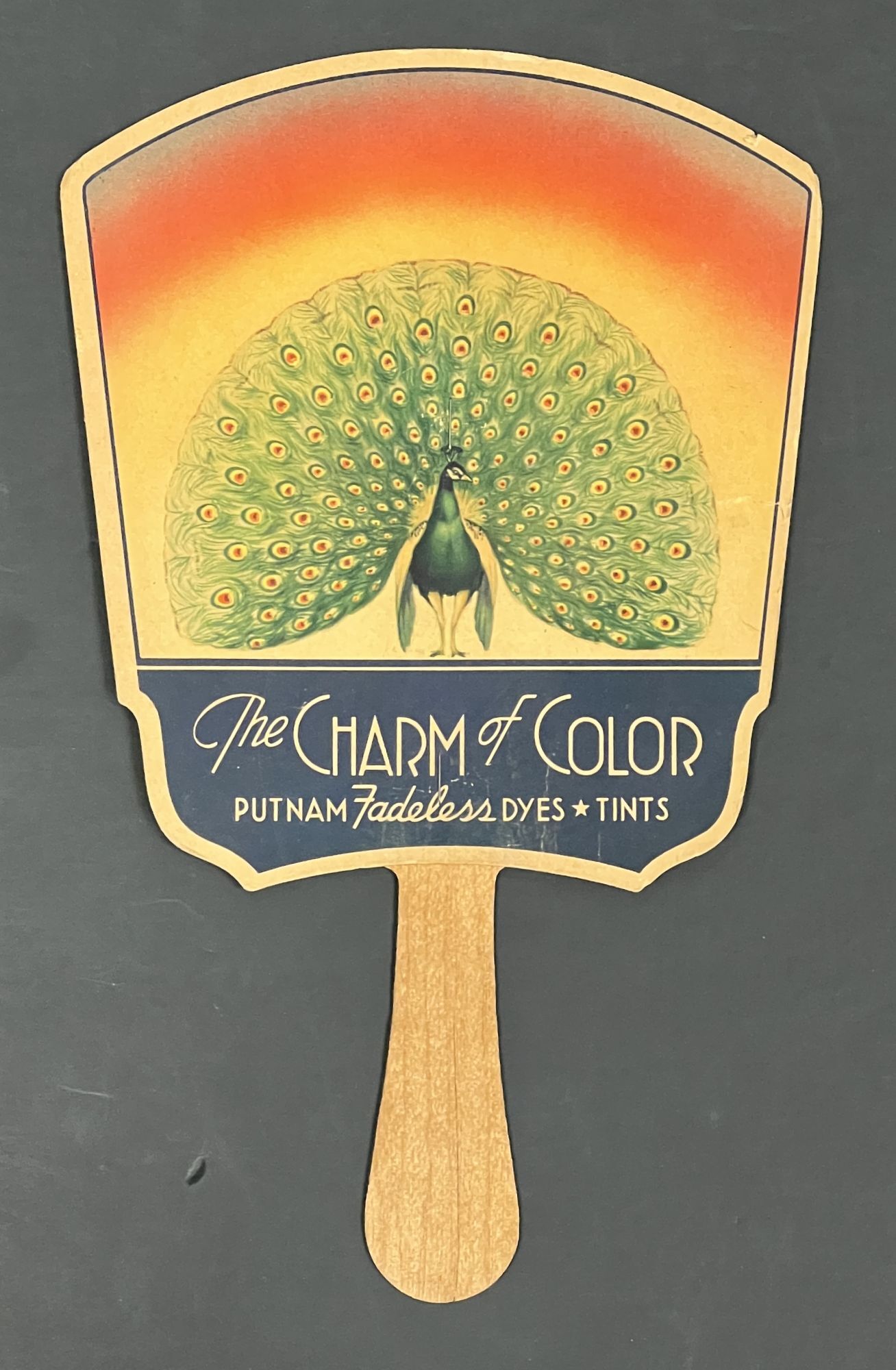
[Early Oklahoma Artifact] — ADVERTISING / MARKETING FAN. Humes & Rowe Drug. 301 W. Grand. Ponca City, Okla
Quincy, Illinois: Monroe Chemical Co, (n. d.). Ca early 1900s, though post-1907. Now housed in a clear archival mylar sleeve. Fan recto with chromolithographed image of a peacock, with the printed caption underneath, "The Charm of Color / Putnam Fadeless Dyes • Tints". Woodend handle stapled to stiff-stock paper 'fan'. Fan: 11-5/16" x 7" [at its widest]. Ponca City is in Kay County, Oklahoma. The city was named after the Ponca tribe. Ponca City was created in 1893 as "New Ponca" after the United States opened the Cherokee Outlet for European-American settlement during the Cherokee Strip land run, the largest land run in United States history. The site for Ponca City was selected for its proximity to the Arkansas River, a railway, and the presence of a freshwater spring near the river at what is modern 13th Street and South Avenue. Ponca City's history and economy has been shaped chiefly by the ebb and flow of the petroleum industry. E. W. Marland, a Pennsylvania oil man, came to Oklahoma and founded the Marland Oil Company, which once controlled about 10% of the world's oil reserves. He founded the 101 Ranch Oil Company, located on the Miller Brothers 101 Ranch, and drilled his first successful oil well on land he leased in 1911 from the Ponca tribe of American Indians. The petroleum industry continued to dominate the Ponca City economy well into the 21st Century. "Putnam dyes were a product of the Monroe Chemical Company in Quincy, Mo. a community in Putnam County for which the dye products are named. The company started out in Unionville, Mo. as the Monroe Drug Company founded by Edward Nelson Monroe (b. 1855, d. 1951) in 1876, later becoming the Monroe Chemical Company. In 1890, Monroe hired James Hugh Elson (b. 1867, d. 1914) who worked as a pharmacist. He was developing a synthetic dye that could be used on a variety of materials namely silk, wool, cotton, linen, rayon, and other mixed goods. Elson combined different types of synthetic dyes to produce his own dye which went on the market in 1893. Response was so great that the company stopped selling drugs in 1895 to concentrate on the marketing of their dyes. The company advertised in many ways using the news media and their own methods. They created hand-held fans to show customers the wide range of colors they offered, produced wall calendars, color charts, paper bags, and sample packets." [McMinn County website]. Here offered in one of the fans used by Putnam. Fan with 1/2" horizontal closed tear to right edge. Handle beginning to split vertically. An About VG copy of this rare survivor.