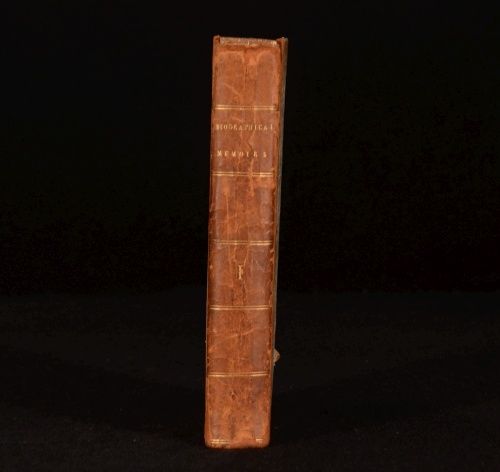
Various — Seven Scarce Biographical Pamphlets
Various, Various, 1650-1713. First edition. Leather. A collection of seven scarce seventeenth and eighteenth-century pamphlets detailing the life, works, letters, deeds and crimes of various men of merit and dishonour. Includes: 1650-London-John Stafford: An Exact Narration of the Life and Death of the Reverend and Learned Prelate, and Painfull Divine, Lancelot Andrews, Late Bishop of Winchester. With a portrait frontispiece. Lancelot Andrewes (1555 Â 25 September 1626) was an English bishop and scholar, who held high positions in the Church of England during the reigns of Queen Elizabeth I and King James I. During the latter's reign, Andrewes served successively as Bishop of Chichester, Ely and Winchester and oversaw the translation of the Authorized Version (or King James Version) of the Bible. 1665-London-William Miller: The Life and Death of Pompey the Great. With all his Glorious Victories and Triumphs. As Also the Life and Death of Artaxerxes Mnemon, one of the Great Persian Emperours. By Sa. Clarke sometime pastor in St. bennet Finck London. Gnaeus Pompeius Magnus, also known as Pompey, was a military and political leader of the late Roman Republic. Pompey and Caesar contended for the leadership of the Roman state, leading to a civil war. When Pompey was defeated at the Battle of Pharsalus, he sought refuge in Egypt, where he was assassinated. His career and defeat are significant in Rome's subsequent transformation from Republic to Principate and Empire. 1689-London-J. Dunton: The Bloody Assizes: Or, a Compleat History of the Life of George Lord Jefferies from His Birth to this present Time. Wherein among other things, is given a true account of his unhead of cruelties, and barbarous proceedings in his whole Western-circuit..None of which were ever publish'd. The Bloody Assizes were a series of trials started at Winchester on 25 August 1685 in the aftermath of the Battle of Sedgemoor, which ended the Monmouth Rebellion in England. They were led by Lord Chief Justice George Jeffreys. George Jeffreys, 1st Baron Jeffreys of Wem, PC (15 May 1645 Â 18 April 1689), was also known as "The Hanging Judge". His historical notoriety comes from his actions in 1685, after Monmouth's Rebellion. Jeffreys was sent to the West Country in the autumn of 1685 to conduct the trials of captured rebels. At these trials, later known as the "Bloody Assizes", Jeffreys issued harsh sentences to nearly all defendants. About 300 were executed, and between 800 and 900 were transported to the West Indies. On 18/19 September alone, he issued 144 death sentences. 1699-London-J. Nutt: Remarks on the Life of Mr. Milton, as publish'd by J. T. with a Character of the Author and his Party in a letter to a member of Parliament. John Milton (9 December 1608 Â 8 November 1674) was an English poet, polemicist, a scholarly man of letters, and a civil servant for the Commonwealth (republic) of England under Oliver Cromwell. He wrote at a time of religious flux and political upheaval, and is best known for his epic poem Paradise Lost. 1706-London-A. Baldwin: The Characters of Robert Earl of Essex, Favourite to Queen Elizabeth, and George D. of Buckingham, favourite to K. James I and K. Ch. I. with a comparison, by the Right Honourable Edward Late Earl of Clarendon. Robert Devereux, 2nd Earl of Essex, KG (10 November 1565 Â 25 February 1601) was an English nobleman and a favourite of Elizabeth I. Politically ambitious, and a committed general, he was placed under house arrest following a poor campaign in Ireland during the Nine Years' War in 1599. In 1601 he led an abortive coup d'etat against the government and was executed for treason. George Villiers, 1st Duke of Buckingham KG (28 August 1592 Â 23 August 1628) was the favourite, claimed by some to be the lover, of King James I of England. Despite a very patchy political and military record, he remained at the height of royal favour for the first two years of the reign of Charles I, until he was assassinated. He was one of the most rewarded royal courtiers in all history. 1711-London-E. Curll: An Account of the Life and Writings of Mr. John Le Clerc (philosophy and Hebrew professor in the College of the Arminians at Amsterdam) to the present year MDCCXI, to which is added, A Collection of Letters, from J. G. Graevius, and Baron Spanheim, to Mr. Le Clerc. With a Particular Account of Dr. Bentley and his two Associates Gronovius and Burman. First edition in English; first published in Latin a year earlier. This narrative purports to be by "a particular friend," but was probably written by Le Clerc himself, some 25 years before his death. 1713-London-Sam Buckley: The Life and Miracles of St. Wenefrede, Together with her Litanies. With some Historical Observations Made Thereon. By Dr. Fleetwood. Including St. Beino's Life and Miracles, translated from the British MS. Saint Winefride was a 7th-century Welsh Christian woman, around whom many historical legends have formed. A healing spring at the traditional site of her death is now a shrine and pilgrimage site called St Winefride's Well in Holywell, Flintshire, Wales known as the Lourdes of Wales. In a half calf binding with marbled boards. Externally sound although rubbed with slight loss to the paper. Internally, firmly bound. Intermittently clean and browned being several different pamphlets in different conditions, but generally clean, just a few spots. Title pages often dusted. One or two copperaplte ink notes to the titles. Some chipping to page edges. Slight loss to the title of St. Wenefrede, not affecting the text. Ink spillage to title of John Le Clerc. Contents written in ink to front blank. Considering the age and scarcity of these works. Very Good . Ill.: None. Very Good .