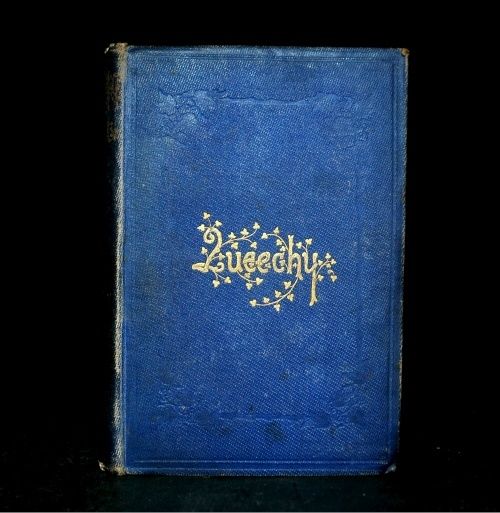
Elizabeth Wetherell (Susan Bogert Warner) — Queechy
London, James Nisbet & Co; Hamilton Adams & Co, 1852. First edition. Cloth. First English edition of Queechy widely admired for its depiction of rural American life. Complete in two volumes. Elizabeth Wetherell was the pseudonym of the writer, Susan Bogert Warner. Susan Bogert Warner (July 11, 1819 Â March 17, 1885), was an American evangelical writer of religious fiction, children's fiction, and theological works. Born in New York City, she wrote, under the name of "Elizabeth Wetherell," thirty novels, many of which went into multiple editions. However, her first novel, The Wide, Wide World (1850), was the most popular. It was translated into several other languages, including French, German, and Dutch. Other than Uncle Tom's Cabin, it was perhaps the most widely circulated story of American authorship. Other works include Queechy (1852), The Law and the Testimony, (1853), The Hills of the Shatemuc, (1856), The Old Helmet (1863), and Melbourne House (1864). In the nineteenth-century, critics admired the depictions of rural American life in her early novels. American reviewers also praised Warner's Christian and moral teachings, while London reviewers tended not to favour her didacticism. Early twentieth-century critics classified Warner's work as "sentimental" and thus lacking in literary value. In the later twentieth century, feminist critics rediscovered The Wide, Wide World, discussing it as a quintessential domestic novel and focusing on analysing its portrayal of gender dynamics. In a uniform cloth binding. Externally, sound. Bumping to the head and tail of the spine, and also to the extremities. Patches of rubbing to the spine, joints, boards and extremities. Both the front and rear hinges are strained but firm. Ink inscription to the front endpaper of each volume. Internally, generally firmly bound, but strained in places with cords showing. Pages are generally clean with with the occasional handling marks and the odd spot. The title page of the second volume is detached but present. Good Only . Ill.: None. Good Only .