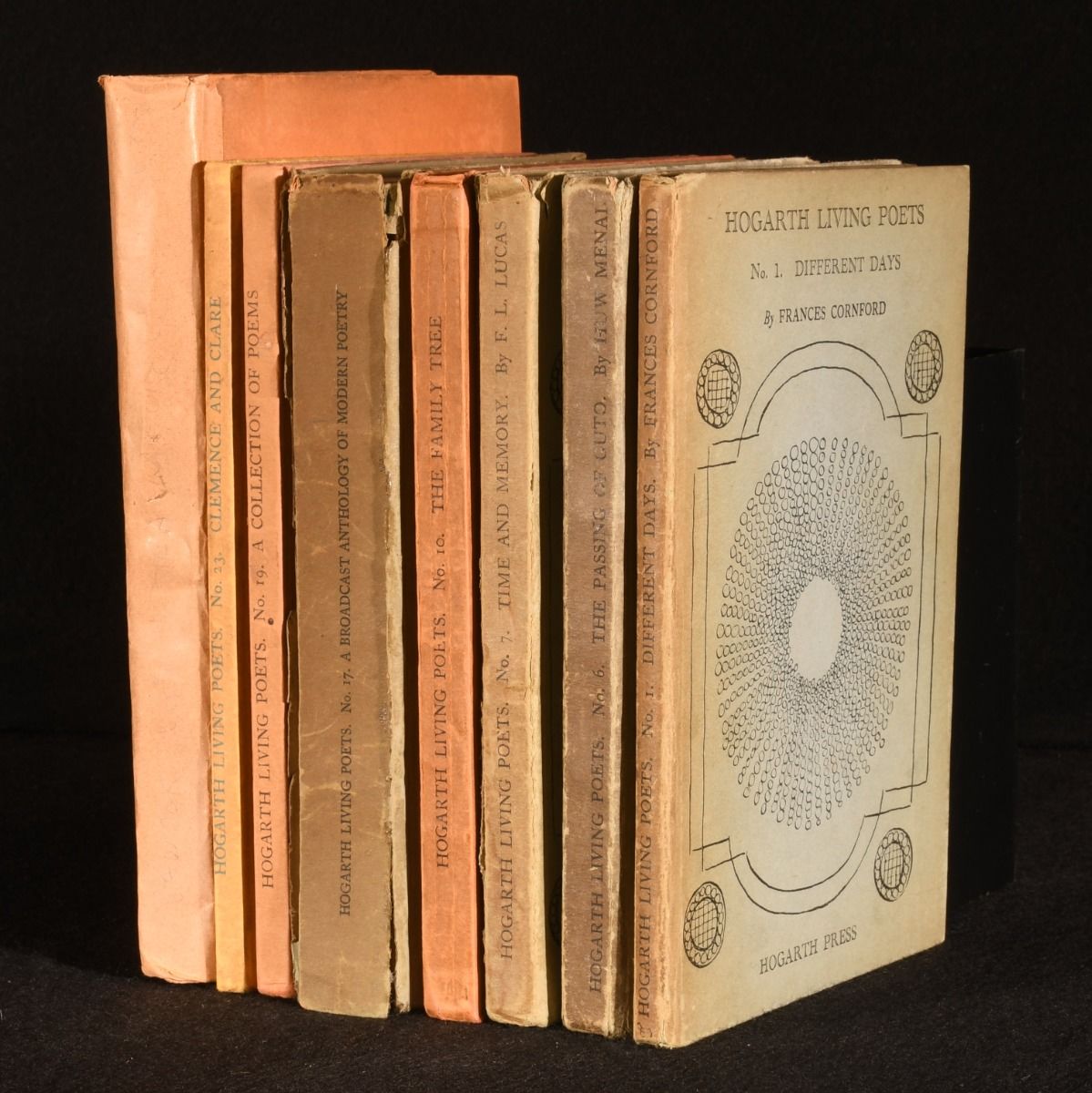
Various — Hogarth Living Poets
London, Leonard and Virginia Woolf at the Hogarth Press, 1928-32. First edition. Hardback. Eight volumes from Hogarth's 'Living Poets' series, scarce as a large set, collecting together poems by leading interwar writers. The first editions, first impressions.A scarce set of Hogarth's 'Living Poets' series, this set containing a total of eight volumes of twenty-four from their first series. A second series published five more volumes from 1933 to 1937.This series was edited by Dorothy Wellesley, Duchess of Wellington, a poet and socialite who, in 1922, left her husband and children for Vita Sackville-West.A sought after set of the works of early twentieth century poets.This set contains:No. 1, 'Different Days' by Frances Cornford, published in 1928. An uncommon work.No. 6, 'The Passing of Guto and Other Poems' by Huw Menai, published in 1929. A scarce work.No. 7, 'Time and Memory' by F. L. Lucas, published in 1929. A very scarce work.No. 10, 'The Family Tree' by William Plomer, published in 1929. A scarce work.No. 12, 'Cawdor' by Robinson Jeffers', published in 1929. A very scarce work.No. 17, 'A Broadcast Anthology of Modern Poetry' by Dorothy Wellesley, published in 1930. An uncommon work.No. 19, 'A Collection of Poems' by Joan Adeney Easdale, published in 1931. A very scarce work.No. 23, 'Clemence and Clare' by Joan Adeney Easdale, published in 1932. A very scarce work.Published by the Hogarth Press, the Bloomsbury publishing house founded ran by Leonard and Virginia Woolf. The press was founded in the interwar period, as printing became a hobby for the couple, diverting Virginia when her writing became too stressful. Both Woolfs' taught themselves to use a printing press, publishing 527 titles from the period of 1917 to 1946. In the original publisher's paper covered boards. Externally, generally smart. Spines are a little age-toned. Light handling marks. Minor bumping to the head and tail of the spines. No. 17 is torn to the joints with some loss and lifting. No. 12 has been rebacked. Marks are heavier to No. 6, in particular to the rear board, with a small amount of loss to the head of the rear board. Boards of No. 1 are age-toned. Head of the spine of No. 7 is lifting. Joints of No. 10 is sunned. Small tidemark to the front board of No. 19. Endpapers of No. 6 have been removed, with wear to the paste downs, front hinge is starting but firm. Internally, firmly bound. Pages are bright and clean, with a few scattered spots. Good . Ill.: None. Good .