AUBERT & CIE — Kaleidoscope, le
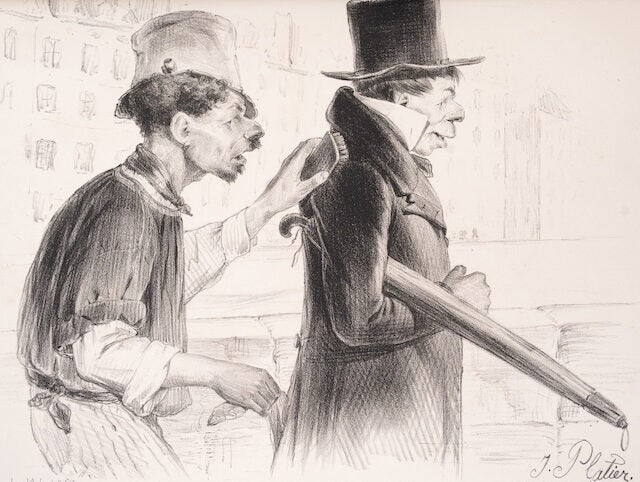
Paris: Aubert & Comp.ie. 1850. A Kaleidoscope of Paris" Forty-One Lithographed Plates by Grandville, Daumier, Gavarni, Platier and Others [AUBERT & CIE.]. Le Kaléidoscope. Dessins de tous genres, par tous les Artistes. Paris: Aubert & Comp.ie, Place de la Bourse, 29, [ca. 1850]. First edition. Folio (13 1/8 x 9 7/8 inches; 333 x 251 mm.). Forty-one lithographed plates by various artists, including J.J. Grandville, Honoré Daumier, Paul Gavarni, Jules Platier and others. Plate 4 printed on mounted papier de Chine; plate 39 shorter than the remainder (approximately 12 x 9 inches; 305 x 229 mm.). With a pictorial lithographed advertisement at end for Aubert's Les Modes Parisiennes. Publisher's original pictorial green boards, front cover elaborately lithographed in black and lettered in gold and black, with the title Le Kaléidoscope. Dessins de tous genres, par tous les Artistes. Aubert & Comp.ie, Place de la Bourse 29. Light wear to spine ends and extremities. Internally remarkably clean and fresh. An exceptional survival in the original publisher's pictorial boards. A fascinating Aubert anthology of French lithographic humor, bringing together forty-one plates by some of the greatest caricaturists and illustrators working in Paris during the extraordinary flowering of lithography in the 1830s and 1840s. The title Le Kaléidoscope is particularly apt. Rather than presenting the work of a single artist or one continuous series, Aubert assembled a constantly changing succession of subjects, styles and comic observations - fashion, courtship, marriage, restaurants, provincial and Parisian manners, domestic life, social ambition, military life and the innumerable absurdities of the bourgeois world. Among the artists represented are J.J. Grandville, Honoré Daumier, Paul Gavarni and Jules Platier, together with other artists associated with the immensely productive Parisian lithographic trade centered upon Aubert. Several celebrated series are represented. The plates include examples from Les Bosses, Les Engoués, Les Grisettes de Paris, Les Restaurateurs de Paris, and other contemporary suites. Particularly striking is Grandville's macabre Voyage pour l'Éternité. Première Étape, in which a skeletal soldier encounters a procession of recruits - a characteristic example of Grandville's extraordinary ability to transform social and political observation into surreal visual fantasy. Other subjects range from fashionable Parisian women and domestic scenes to restaurants, marriage, flirtation and bourgeois pretension. One plate from Les Restaurateurs de Paris shows a customer addressing a waiter; another from Les Bosses presents the wonderfully named Bosse de la Philanthropie; the Grisettes plates examine the lives and manners of the young working women who became one of the characteristic social types of nineteenth-century Paris. The collection therefore amounts to considerably more than an album of comic prints. It provides a remarkably varied visual cross-section of Parisian popular culture at the height of the illustrated press, when lithography had become one of the principal vehicles through which contemporary manners, politics, fashions and social types were observed and satirized. Maison Aubert, established by Charles Philipon and his brother-in-law Gabriel Aubert, occupied a central position in the development of nineteenth-century French caricature. From its premises in the Passage Véro-Dodat and later at the Place de la Bourse, Aubert published and distributed an enormous range of lithographs and illustrated albums and was closely associated with such artists as Daumier, Grandville, Gavarni and Cham. Its publications, together with Philipon's celebrated journals La Caricature and Le Charivari, helped make lithographic caricature one of the defining artistic forms of July Monarchy Paris. The present album is an especially appealing manifestation of Aubert's publishing enterprise: instead of concentrating upon one artist, Le Kaléidoscope deliberately advertises itself as containing "Dessins de tous genres, par tous les Artistes" - "Drawings of every kind, by all the artists." The pictorial advertisement preserved at the end promotes Maison de Commission des Modes Parisiennes, Rue Louis le Grand No. 9, declaring that everything connected with fashion could be obtained through the establishment and that orders should be addressed to F. G. Bourgeois. Its preservation provides an unusually evocative glimpse into the commercial world in which albums such as Le Kaléidoscope were sold. The album's remarkable variety is perfectly encapsulated by its title: like the optical toy from which it takes its name, every turn of the page produces another arrangement of characters, fashions and follies. A remarkably fresh and appealing anthology of French lithographic caricature, containing forty-one plates by Grandville, Daumier, Gavarni, Platier and their contemporaries, preserved in the publisher's delightful original pictorial boards. .