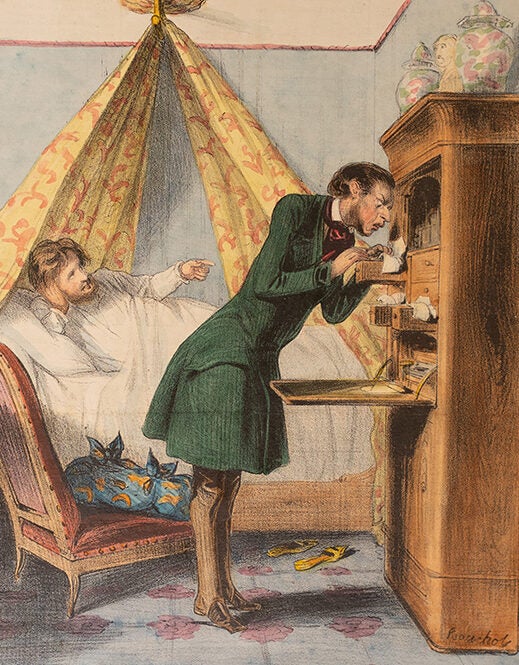
BOUCHOT, Frédéric — Debiteurs Et Créanciers
Paris: Aubert & Cie. 1837. One of the Finest Surviving Collections of Frédéric Bouchot's Hand-Colored Lithographs A Brilliant Panorama of Bourgeois Life, Urban Comedy, and Social Satire in July Monarchy Paris BOUCHOT, Frédéric. Débiteurs et Créanciers; Contributions indirectes; Après le carnaval; Les Malheurs d'un amant heureux; together with Les embellissements de Paris and Trop tôt. Paris: Aubert & Cie; Lemercier, Bernard et Cie, [ca. 1837-1840s]. Large quarto (13 3/4 x 10 1/4 inches; 350 x 260 mm.). An extraordinary composite album preserving approximately seventy original lithographs by the French caricaturist Frédéric Bouchot (1798-after 1850), comprising six celebrated satirical series issued during the great flowering of French illustrated caricature under the July Monarchy. The overwhelming majority of the plates are beautifully hand-colored, several heightened with gum arabic, the coloring throughout remarkably fresh and delicately executed. The album contains complete examples of Les Débiteurs et les créanciers (12 plates), Contributions indirectes (20 plates), Les Malheurs d'un amant heureux (12 plates), together with substantial portions of Après le carnaval, Les embellissements de Paris, and Trop tôt. Several plates remain mounted upon their original contemporary newspaper leaves, preserving printed text versos exactly as first issued, while others survive on contemporary card mounts of varying sizes, eloquent evidence of the album's nineteenth-century compilation. Several leaves detached, including all of Trop tôt; stubs from canceled leaves between Les embellissements de Paris and Trop tôt. Marginal tear to Trop tôt, plate 4, affecting border and printer's imprint. Some occasional browning, foxing, and light marginal damp-staining, but the lithographs themselves generally remarkably clean, bright, and visually impressive. Bound circa 1900 in ochre cloth over floral-patterned boards, spine with black morocco label lettered in gilt. Contemporary etched bookplate depicting a dog on the front pastedown. Manuscript table of contents in blue crayon and pencil on the front endpaper. Far more than a miscellaneous collection of comic prints, the present volume constitutes an exceptionally coherent survey of Bouchot's graphic achievement. Although today somewhat eclipsed by Daumier and Gavarni, Bouchot ranks among the finest observers of bourgeois society during the 1830s and 1840s. His lithographs combine elegant draftsmanship, theatrical narrative, and an acute eye for social behavior, exposing the pretensions, anxieties, and absurdities of everyday Paris with wit that remains remarkably fresh. Unlike Daumier's often brutal exaggeration, Bouchot's comedy depends upon expressive gesture, carefully observed facial expression, and brilliantly staged compositions. Each sheet unfolds like a miniature theatrical production. Doorways, staircases, mirrors, wardrobes, salons, and shop interiors become dramatic settings in which creditors, lovers, servants, tradesmen, dandies, and fashionable ladies perform the endless comedy of bourgeois existence. The hand-coloring throughout greatly enhances these theatrical qualities. Executed with transparent washes of exceptional refinement, it animates fashionable costumes, richly patterned wallpapers, elegant furnishings, and domestic interiors while preserving the softness and richness of the original lithographic crayon. The impressions themselves are notably fresh, retaining the velvety tonal quality characteristic of the finest productions of Aubert and Lemercier. The complete suite Les Débiteurs et les créanciers is undoubtedly the jewel of the collection. Through twelve brilliantly observed scenes Bouchot transforms ordinary commercial transactions into comic theater, depicting tailors, boot-makers, hairdressers, upholsterers, moneylenders, innkeepers, and furniture dealers pursuing increasingly desperate attempts to recover unpaid accounts. Beneath the humor lies an affectionate yet penetrating portrait of the fragile financial respectability upon which bourgeois society depended. Equally inventive, Contributions indirectes imagines taxation as a universal metaphor governing every aspect of social life, inventing absurd "taxes" upon love, vanity, domesticity, flirtation, and even infancy itself. Après le carnaval explores the melancholy return to reality after masquerade, exposing exhausted revelers and discarded disguises with characteristic irony, while Les Malheurs d'un amant heureux presents an extended romantic farce worthy of Balzac, chronicling the humiliations suffered by an over-persistent lover through a sequence of increasingly elaborate comic disasters. Perhaps the most historically engaging series is Les embellissements de Paris, in which Bouchot gently mocks the ambitious urban improvements transforming the capital during the years immediately preceding Haussmann. Public fountains, wooden pavements, civic monuments, ornamental urinals, and fashionable promenades become subjects for affectionate ridicule, preserving an unusually vivid visual record of the evolving modern city. Throughout the album Bouchot proves himself an exceptionally sensitive recorder of contemporary Parisian life. His lithographs document not merely costume but furniture, wallpapers, mirrors, shop fittings, domestic architecture, street furniture, trades, and manners with remarkable precision. Read collectively, they form an invaluable pictorial chronicle of middle-class life in Paris during the final years of the July Monarchy. A magnificent visual theater of bourgeois Paris, preserving one of the most extensive and attractive surviving collections of Frédéric Bouchot's satirical lithographs. Equally inventive, Contributions indirectes transforms taxation into social allegory, parodying the hidden "costs" attached to everyday existence. Among the absurd levies depicted are the "Impôt nourricier," consisting of a baby's first tooth owed to the wet nurse, and the "Impôt moral," exacted upon a gentleman at a ball who is forced to dance with neglected ladies. Après le carnaval explores the melancholy collapse of illusion after masquerade festivities, exposing the desperate and often pathetic realities hidden beneath carnival costume. In Les Malheurs d'un amant heureux, Bouchot turns to romantic farce worthy of Balzac: the unfortunate lover hides in wardrobes, is shot by gardeners, and ultimately compelled to pay 12,000 francs to secure marriage to his beloved. The satirical urbanism of Les embellissements de Paris is particularly delightful, ridiculing both Parisian civic "improvements" and the naïve tourists who admire them - including public urinals romantically titled "colonnes moresques" and the notorious elephant monument at the Bastille. Finally, Trop tôt develops an extended visual pun on unfortunate timing, from suspiciously premature childbirth to overconfident ice skaters taking a "free bath" before winter properly arrives. Composite albums of hand-colored French satirical lithographs from this period are now rarely encountered, especially preserving multiple complete suites in contemporary color. The survival of ephemeral newspaper mounts, varied paper stocks, and period compilation structure gives this volume unusual documentary importance alongside its considerable decorative and artistic appeal. A vivid and highly entertaining panorama of Parisian society during the golden age of French caricature. .